
The Digital Divide: A Myth and a Real Problem
Our children are not less capable. The infrastructure and the curriculum are less present.
The Black American Party advances the producer class of the Black American community — through ownership, enterprise, constitutional principle, and economic solidarity. What is good for Black Americans is good for all Americans.
Police work should be done by officers held to a far higher standard of education in human psychology and sociology.

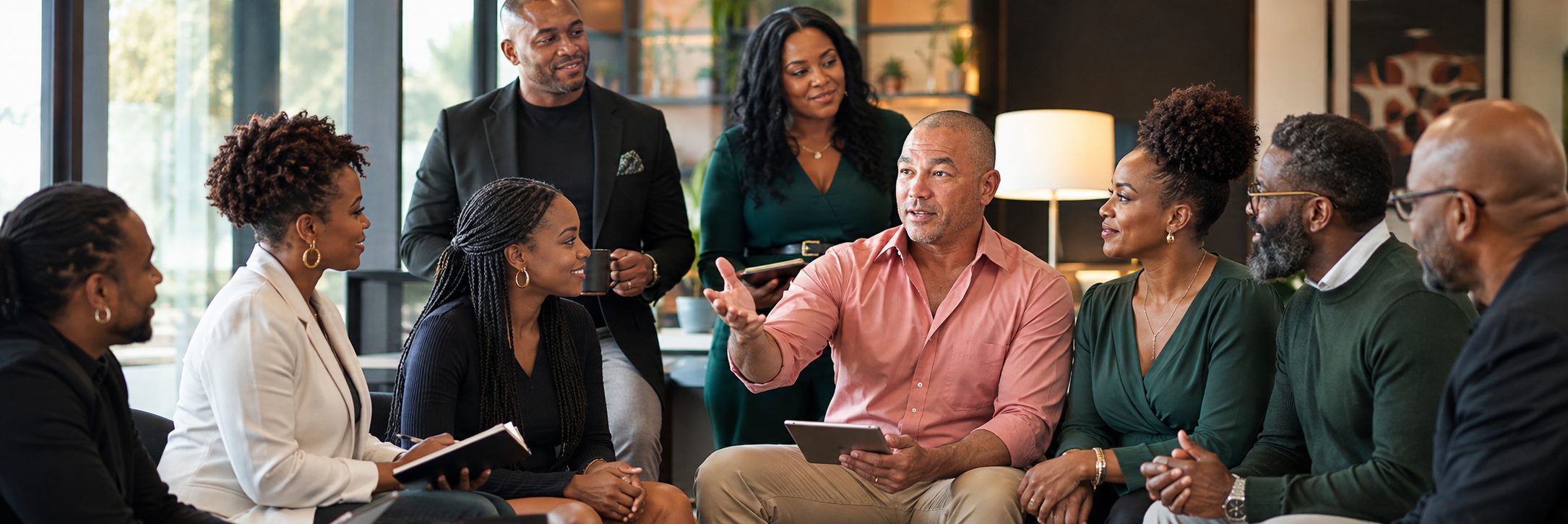
The Black American Party holds that police work should be performed by officers who meet a much higher standard of education in human psychology and sociology.
This is not a softer position than the ones usually offered. It is a harder one. It says the job as currently constituted is being done by people who have not been prepared for it, and that the community which absorbs the consequences is entitled to demand preparation.
In 2022 the average basic training program at a state or local law enforcement academy in the United States ran 806 hours. There is no national standard; the requirement is set separately by roughly eighteen thousand agencies.
Finland, Norway and the Netherlands train police officers for about three years. Germany requires on the order of four thousand hours; the United Kingdom roughly twenty-two hundred. A licensed cosmetologist in most American states trains longer than an American police officer does.
That is the whole argument in one comparison. The United States hands lethal authority and near-total discretion to people who have been in a classroom for a few months, and then treats the outcome as a mystery.
Because that is what the work actually consists of. The overwhelming majority of police contacts are not firefights. They are mental health crises, domestic disputes, intoxication, homelessness, adolescents behaving like adolescents, and people having the worst day of their lives. An officer trained principally in weapons and tactics meets those situations with the only tools he was given.
An officer who has genuinely studied human behavior reads a scene differently. He can tell the difference between a man who is dangerous and a man who is frightened, between defiance and disorientation, between a boy posturing and a boy about to do something. Those distinctions are the difference between a report and a funeral.
And sociology is the part nobody wants to require: an officer working in a Black American neighborhood should be required to have studied how that neighborhood came to be the way it is. Policing a community whose history you have never been taught is how a person mistakes the results of policy for the character of a people.
Black American communities carry two problems at the same time and are usually only permitted to discuss one. There is police misconduct against Black Americans, which is real and documented. And there is violent crime inside Black American neighborhoods, which is also real, and which the residents of those neighborhoods want addressed.
Most political offerings ask us to pick one. This party refuses the choice. The mother who has buried a son shot by an officer and the mother who has buried a son shot on a corner are frequently the same woman, and she is not confused about what she wants. She wants police who are competent, accountable, and present.
A higher standard for the badge serves both demands with one instrument. Better-educated officers make fewer catastrophic errors, and departments that recruit for that standard become places Black Americans are willing to work, which is its own form of accountability.
The party has not stated a required number of hours, a degree requirement, a certifying body, or how a standard would be enforced across eighteen thousand independent agencies. It has not taken a position here on qualified immunity, civilian review boards, residency requirements or funding levels.
Those are separate questions and they will be answered separately, in consultation with the people who live under the answer.
That police work should be performed by officers meeting a much higher standard of education in human psychology and sociology than American policing currently requires.
The Bureau of Justice Statistics reported an average basic training program of 806 hours in 2022, with no national standard - the requirement is set by roughly 18,000 separate agencies.
Finland, Norway and the Netherlands train officers for about three years. Germany requires roughly 4,000 hours and the United Kingdom about 2,250.
No. The party holds both demands at once - that misconduct is real and that residents of Black American neighborhoods want crime addressed - and treats a higher standard for the badge as the instrument that serves both.
Not yet. It has not named an hours requirement, a degree requirement, a certifying body, or an enforcement mechanism, and does not pretend to have resolved qualified immunity or funding levels here.
Our children are not less capable. The infrastructure and the curriculum are less present.
Every other institution this platform proposes is downstream of this one.
One cultural practice we defend with humour is measurably harming the next generation.
A community serious about its children cannot leave them in other people's systems.
A party that cannot say precisely who it represents will end up representing whoever funds it.
A vote that is guaranteed is a vote that is worthless.
$10 a month for the private members network, business referral and local organizing.
Become a member →Twelve chapters and 200+ cited lessons. One-time $40, one year of access.
Enroll now →